
Cyber War with foreign actors: What businesses should know
US medical equipment provider Stryker said recently that its global networks were disrupted by a cyberattack, allegedly carried out by a hacking group linked to Iran. The attack impacted Stryker’s internal Microsoft environment and deleted information from devices, with one employee telling a news network that company phones stopped working, grinding work and communications to a standstill.
News like this can be especially troubling. When geopolitical tensions and conflicts exist, the battlefield expands beyond air, sea, and land. It also extends to the digital world. As conflict involving Iran, Israel, and Western allies intensifies, cybersecurity experts and government agencies have warned that there could be retaliatory cyberattacks.
Are American organizations in greater danger of being targeted with cyberattacks? And, if so, what can companies do to protect themselves?
Some government officials and researchers believe these kinds of cyberattacks have been going on for years. And in periods of unrest, it is important to be prepared when it comes to cyberattacks.
Is cyber retaliation already happening?
Recent events suggest that cyber operations connected to foreign actors are already occurring against Western organizations.
Cybersecurity analysts say these incidents illustrate how cyber conflict can accompany global tensions. Foreign-linked hacking groups have increasingly targeted organizations in government, healthcare, technology, and critical infrastructure sectors.
Government agencies in the United States, including the Cybersecurity and Infrastructure Security Agency (CISA), the FBI, and the National Security Agency, have repeatedly warned that U.S. networks and infrastructure could be targeted, particularly during periods of political or military confrontation.
These operations often involve:
- Distributed denial-of-service (DDoS) attacks designed to overwhelm systems
- Phishing campaigns aimed at stealing login credentials
- Malware designed to steal data or destroy systems
- Exploitation of unpatched software vulnerabilities
Many attacks are relatively low-cost for the attacker but can cause significant disruption to organizations that are unprepared.
Why cyber warfare appeals to nation states
Cyberattacks are less expensive than military operations, making them an appealing option to foreign actors. A small team of skilled hackers can disrupt systems used by large organizations or government agencies.
Cyber activity can also be difficult to attribute with absolute certainty. Hackers often operate through proxy groups or “hacktivist” collectives that make it difficult to pinpoint who is behind the attack.
And cyberattacks can be targeted at economic and infrastructure systems rather than military targets. Power grids, hospitals, transportation networks, and corporate data centers all rely heavily on digital systems.
Because of these characteristics, cyber operations have become a central element of modern geopolitical competition.
What types of organizations are most at risk?
Although any organization connected to the Internet could be targeted, some sectors face greater risks.
According to cybersecurity advisories and threat intelligence reports, Iranian cyber actors frequently focus on:
- Critical infrastructure such as energy, water systems, and transportation
- Healthcare systems and medical device companies
- Government agencies and municipalities
- Technology and defense contractors
- Financial institutions
Attackers often begin with easier targets. Many successful cyber intrusions occur because organizations fail to apply basic security practices such as patching vulnerabilities or using strong authentication.
Government advisories note that foreign actors often exploit unpatched software, weak passwords, or poorly secured internet-connected devices to gain access to networks.
In other words, sophisticated adversaries often succeed because organizations neglect basic cybersecurity hygiene.
What should you, as a business owner, be thinking about during these times?
Six steps businesses should take now
The good news is that most cyberattacks, whether conducted by criminals or nation-state actors, can be mitigated by implementing well-established cybersecurity practices. Here are several steps companies and organizations should prioritize.
1. Enforce multi-factor authentication
Stolen passwords continue to be one of the most common entry points for attackers. Requiring multi-factor authentication, such as a mobile app approval or hardware security key, can dramatically reduce the likelihood of account compromise.
2. Patch systems and software regularly
Many attacks succeed because organizations delay installing security updates. Vulnerabilities in operating systems, servers, and network devices are often publicly documented, making them easy targets for attackers. Routine patch management is a simple and effective defense.
3. Segment critical systems
Many businesses connect all systems to a single network. If an attacker compromises one device, they could gain access to everything.
Separating systems such as finance, operations, and industrial controls, helps limit the damage if an intrusion occurs.
4. Strengthen Email security and employee awareness
Phishing remains one of the most common attack techniques. Employees should receive training on identifying suspicious messages and verifying unexpected requests for credentials or financial transfers.
Advanced email filtering tools can also reduce risk.
5. Back up critical data
Some cyberattacks attempt to destroy or encrypt data. Organizations should maintain secure offline backups and test their ability to restore systems regularly. Doing so can dramatically reduce the impact of ransomware or destructive malware attacks.
6. Work with cybersecurity professionals
Many organizations do not have the internal expertise needed to monitor and defend their networks against sophisticated threats.
Managed IT providers and cybersecurity specialists can help with:
- Continuous network monitoring
- Threat detection and response
- Security assessments
- Incident response planning
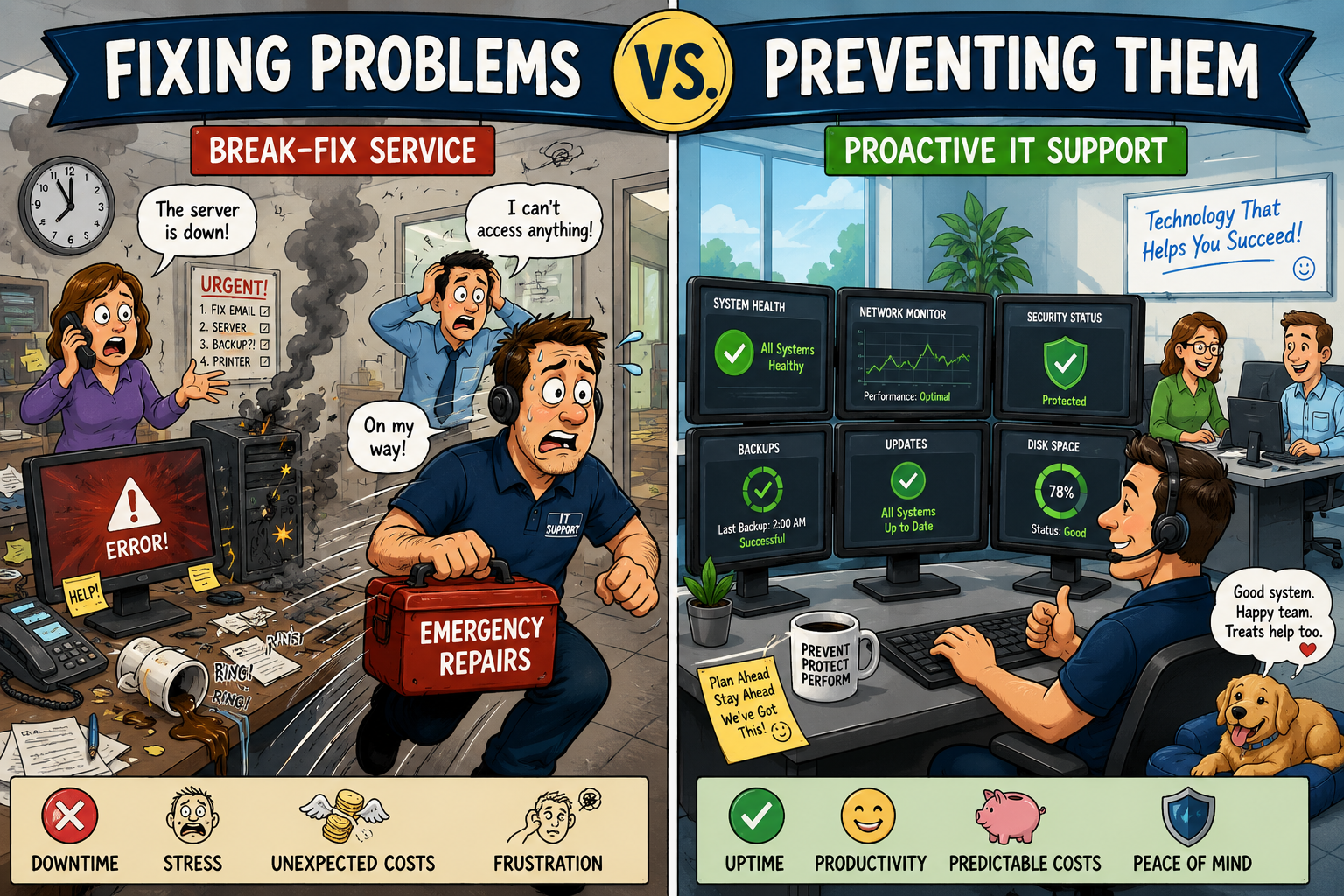
A proactive approach often costs far less than recovering from a major cyber incident.
Cybersecurity Is now a business risk
News headlines have reported cyberattacks from foreign nations and that is an attention-getter. It is also important to remember that cyber threats are not limited to international conflicts. Cybercrime costs organizations worldwide hundreds of billions of dollars every year.
And periods of international tension can increase the risk of disruptive cyber activity from individuals seeking political or economic leverage.
For business leaders, the takeaway is that cybersecurity is not just an IT issue. It is a core business risk. Companies that invest in proactive security measures are far better positioned to withstand both criminal attacks and the evolving realities of cyber warfare.
With seven decades’ experience, we can help you develop a proactive IT approach that will benefit your business and protect your business from unwanted intruders.
If you have questions or concerns about your IT and network, let’s have a conversation. Please give us a call at 888-357-4277 or visit https://pulsetechnology.com. We are here to help.