
Why proactive IT support beats the break-fix model for today’s businesses
For many businesses, technology is a bit like electricity or running water. You don’t think too much about it until something stops working.
And then the headaches begin.
When a server crashes, employees can't access files, which can include everything from deadline-sensitive projects to the current week’s payroll.
When the network goes down, productivity grinds to a halt. When ransomware strikes, the consequences can be devastating. You get the idea. Cyber attacks are no fun.
Unfortunately, many organizations still rely on the "break-fix" model of IT support, calling for help only after a problem has already occurred. And at that point the “wait until something doesn’t work” practice can have costly and disastrous repercussions.
For many small and mid-sized business owners, the rationale for this approach appears to be cost-driven. It may seem less expensive than partnering with a Managed Services Provider (MSP), but it often ends up costing significantly more over time.
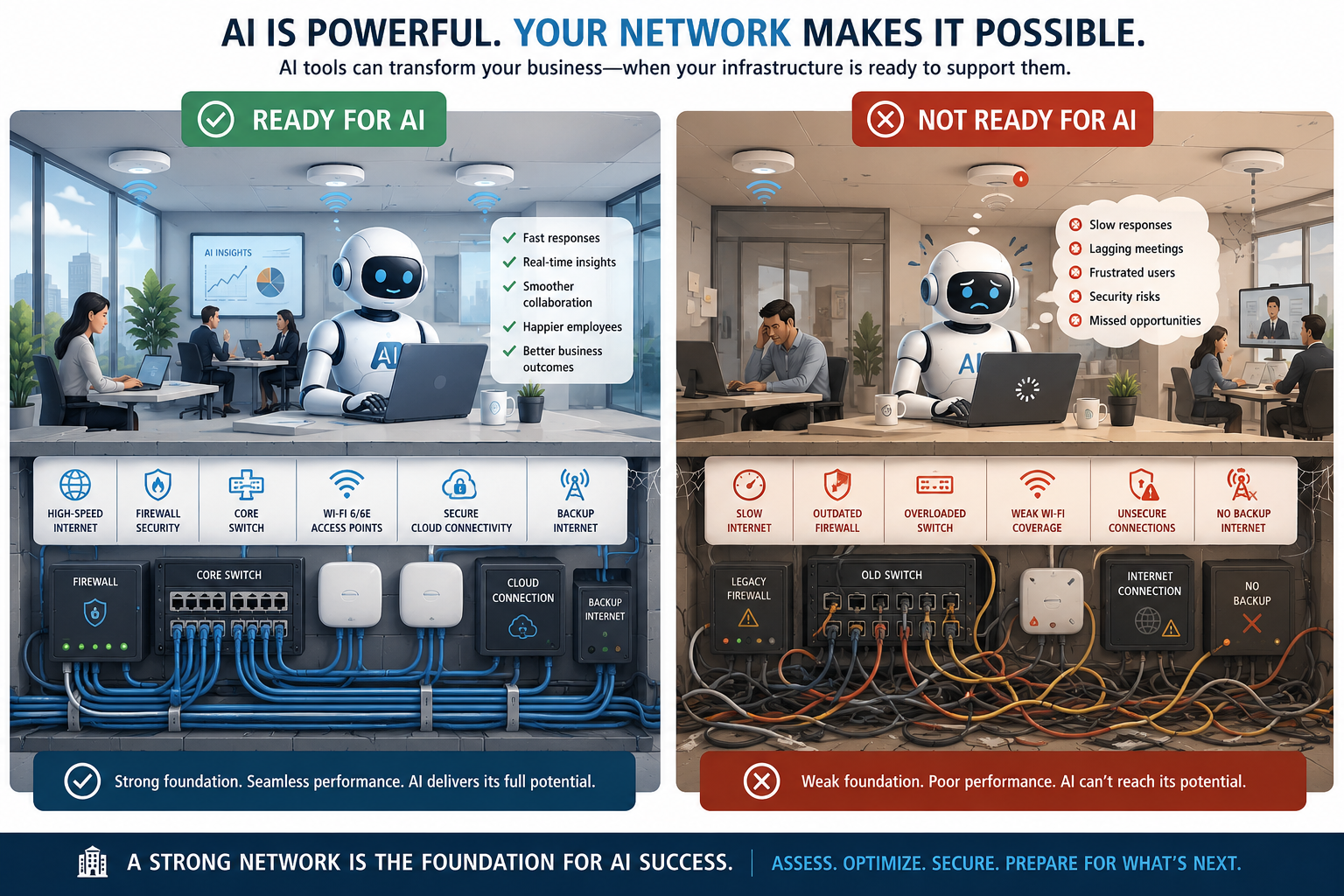
With a Managed Services Provider, you have proactive support. Your team focuses on preventing problems before they interrupt business operations. Instead of reacting to emergencies, the proactive approach continuously monitors, maintains, and improves a technology environment to reduce risk and maximize uptime.
Managed Network Services, or proactive IT, seems to be catching on as businesses become more aware of the potential disaster that an attack can cause. And cyberattacks are all too prevalent in today’s business climate. In 2025, the FBI recorded 1,008,597 attacks in the US in that single year. Cyberattacks have surged 187% since 2018, rising from 351,937 (still far too many!) to today’s levels. At 2,765 attacks per day, the threat is real and all around us.
Among managed service providers themselves, break-fix work has become a smaller part of their business. One industry benchmark survey reveals that among Managed Service Providers (MSPs), break-fix accounted for only about 13% of average MSP revenue, while managed services represented about 30%. That reflects a significant industry shift toward recurring, proactive support.
Here’s why the proactive approach makes good business sense.
Understanding the difference between break-fix and proactive IT
The break-fix model is exactly what it sounds like.
Something breaks. You contact an IT provider. They diagnose the problem, repair it, and you pay their invoice. The relationship is largely reactive and often transactional. The IT provider in this situation is called to fix a specific problem, not analyze a network.
And, for many businesses, if nothing appears to be wrong, little or no maintenance takes place.
Proactive IT support works differently. Systems are monitored around the clock, software updates are managed regularly, security vulnerabilities are addressed promptly, backups are verified, and potential problems are identified often before users even notice them.
Rather than waiting for technology to fail, proactive support is designed to keep it running reliably.
Downtime Is more expensive than most businesses realize
When there is a glitch in the technology, many business owners focus on the cost of repairing a computer or replacing hardware. What they often overlook is the cost of downtime.
When technology isn't working, employees may be unable to access customer information, process orders, communicate with clients, print important documents, conduct online meetings, and complete daily work. What is the cost of a predicament like this to a business?
It can be extremely significant. Even a short outage can affect customer satisfaction, employee productivity, and revenue.
Two things to remember: (1) In many cases, the indirect costs of downtime far exceed the repair bill itself; and (2) Preventing downtime is almost always less expensive than recovering from it.
Problems rarely happen without warning
Technology failures are often preceded by warning signs. These signs can include hard drives beginning to fail, storage space nearing capacity, servers running unusually hot, backup jobs failing, and security software becoming outdated.
Without monitoring, these warning signs may go unnoticed until they become major disruptions. However, with proactive monitoring, many issues can be corrected long before users experience any interruption.
Better cybersecurity starts with prevention
Cybersecurity is a compelling reason why a business should consider adopting the proactive, or Managed IT approach.
Today's cybercriminals find small and mid-sized businesses increasingly attractive because they often have fewer security resources than large corporations. In fact, 43% of cyber attacks are directed at small and mid-sized businesses of 500 employees or less.
The proactive approach helps reduce risk by ensuring that operating systems receive security patches promptly, antivirus and endpoint protection remain current, firewalls are monitored and updated, user accounts are reviewed regularly, multi-factor authentication is implemented, and suspicious network activity is investigated quickly.
No security program can eliminate every threat, but reducing vulnerabilities dramatically lowers the chances of a successful attack. Waiting until after a breach occurs is both expensive and disruptive.
Predictable costs make budgeting easier
One challenge with break-fix service is the uncertainty of costs. A business might go months without needing a “fix” but then something may come up requiring emergency service calls, replacement hardware, data recovery, network repairs, and overtime labor costs. Unexpected technology costs can make budgeting difficult.
Proactive support programs can provide more predictable monthly costs while reducing the likelihood of expensive emergency repairs. Instead of paying for crises, businesses invest in keeping systems healthy.
Proactive IT will help employees stay more productive
Few things frustrate employees more than unreliable technology, including:
- Slow computers.
- Dropped network connections.
- Applications that freeze.
- Printers that won't respond.
- Email issues.
Each individual problem may only consume a few minutes, but across an entire organization those lost minutes become hours, and possibly days, of reduced productivity. When systems are maintained properly, employees spend less time troubleshooting technology and more time serving customers and completing meaningful work.
Planning wins over reacting every time!
Technology should support business goals, not create obstacles. Proactive IT providers don't simply repair computers. They help businesses plan for future needs.
This includes evaluating questions such as:
- Is aging hardware nearing the end of its useful life?
- Are storage requirements growing?
- Is the current network capable of supporting expansion?
- Are backup and disaster recovery plans adequate?
- Are software licenses current?
- Is cloud migration worth considering?
Addressing these questions before they become urgent allows businesses to make thoughtful, strategic decisions instead of rushed emergency purchases.
Regular maintenance extends equipment life
Just as routine maintenance helps extend the life of a vehicle, regular IT maintenance can improve the longevity and reliability of business technology. Routine tasks include:
- Installing updates
- Removing unnecessary software
- Monitoring hardware health
- Cleaning up storage
- Verifying backups
- Reviewing system performance
These relatively simple activities help reduce failures while maximizing the value of existing technology investments.
Peace of mind has real value
Business owners already have enough responsibilities. Between managing employees, serving clients, planning overall growth strategy, and understanding and complying with regulations. Technology shouldn't become another daily worry.
Knowing that systems are being monitored, maintained, and protected allows leadership to focus on running the business rather than responding to unexpected IT emergencies.
That confidence can be difficult to quantify, but it provides meaningful value.
The bottom line for your business: why Managed IT matters
Break-fix IT service may appear economical because businesses only pay when something goes wrong. But by the time a repair is needed, productivity has often been lost, customers may have been affected, and the repair itself may be more costly than preventive maintenance would have been. And that doesn’t even take into account the bigger picture of liability and reputation/brand damage that a serious breach can cause.
Proactive IT support shifts the focus from repairing problems to preventing them. Through continuous monitoring, regular maintenance, timely security updates, and long-term planning, businesses can reduce downtime, improve cybersecurity, extend the life of their technology, and create a more stable environment for employees and customers alike.
In today's increasingly digital workplace, reliable technology is no longer simply a convenience. It is a business necessity. Investing in proactive IT support helps organizations spend less time dealing with unexpected disruptions and more time focusing on serving customers and growing their business.
If you are thinking about upgrading to a Managed Services approach, or even just have specific questions about how it would work for your organization, let’s have a conversation. With seven decades experience in “all things technology” and as a company that specializes in IT/Managed Services, we are here to help. Give us a call at 888-357-4277 or visit https://pulsetechnology.com. Let’s talk!